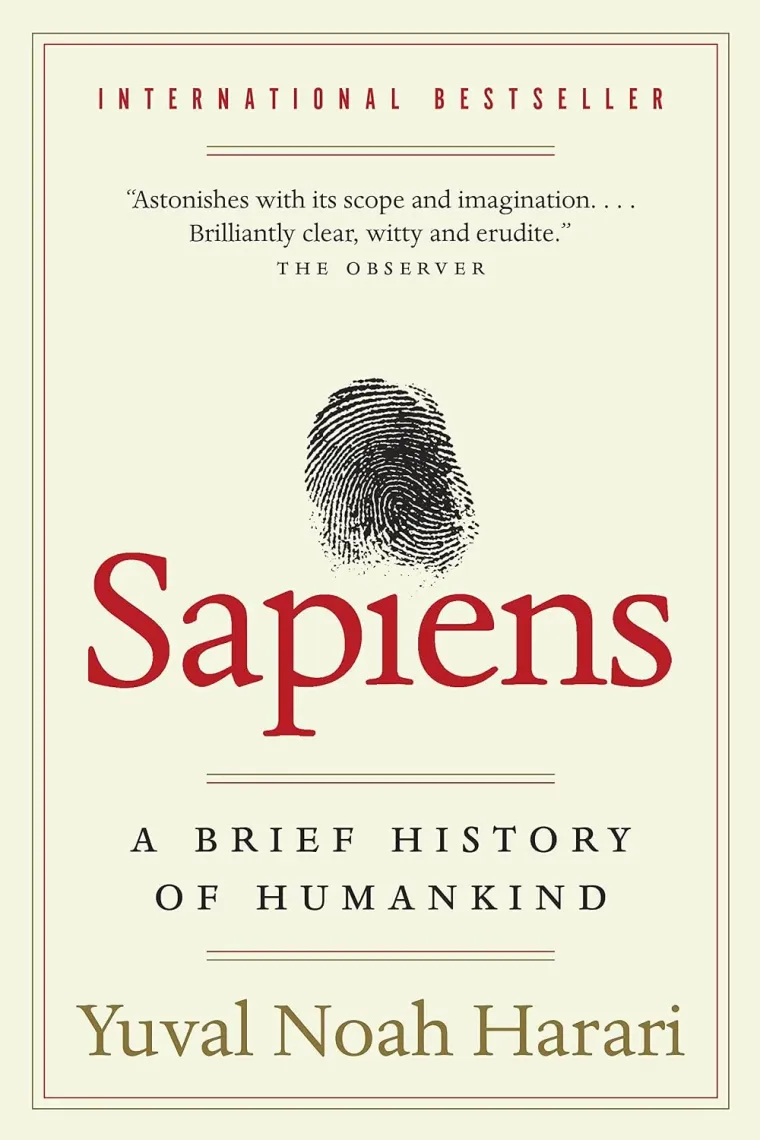
Sapiens
Before you read
Genre Non-Fiction
Pace Slow
Mood Reflective · Informative · Challenging
Content warnings (5) tap to show
- Violence
- Sexual assault
- Animal death
- Racism
- War
My Score
My Review
Sapiens looks at the history of humanity on a huge scale, from early Homo sapiens through agriculture, religion, empires, money, science, and the modern world. What I liked most was how Harari connected things I’d normally think of as completely separate and showed how much of society depends on shared ideas people agree to believe in.
This book left me thinking about things I hadn’t expected to question. Some of the arguments are broad and I wouldn’t take every conclusion as settled fact, but that’s also part of what made it interesting for me. It’s easy to read for a book covering such a massive subject, and even when I disagreed with parts of it, I kept stopping to think about the bigger point he was making.
The Goods
- Makes huge ideas easy to follow
- Connects history, biology, and culture really well
- Plenty of thought-provoking arguments
- Very readable for such a broad subject
- Gives you a lot to think about afterward
The Bads
- Some arguments are oversimplified
- A few claims are presented too confidently
- The scope is almost too big for one book
- Certain sections are stronger than others
- Not every conclusion will convince everyone
My Recommendation
This is a great fit if you like nonfiction that tries to explain the big picture instead of focusing on one narrow period of history. I liked that Sapiens kept making connections between human behaviour, culture, religion, economics, and science in ways I hadn’t really thought about before. If you enjoy books that make you question why societies work the way they do, even when you don’t agree with every argument, there’s a lot here that’s worth thinking about.
Spoilers Tap to show: only if you’ve read it, or don’t mind knowing what happens
Harari surveys human history through the Cognitive, Agricultural, and Scientific Revolutions, arguing that shared stories and institutions let large groups cooperate. He questions whether greater power has consistently produced greater happiness, then ends by considering biotechnology and humanity's possible transformation beyond its current form.
Find this book at these locations
To buy
- Amazon paperback or hardcover
To listen
- Audible free sample
E-books
- Kindle
- Google Play Books
- Libby free from your library
More reviews: Goodreads · The StoryGraph